WORK

WORK. It's what we do, what we obsess over, celebrate, complain about, get paid for. We may call it Art, but it's still work. Particularly for creative types, where we do our work must have something to do with how it turns out, for better or worse - yet we rarely get to see behind the curtain.

We would like you to share something about your special place where creativity blooms. So where do you work?

Wednesday, September 7, 2011

Staffs & Chaffs

Doug & his Tres
Doug Pauly draws creative inspiration from many sources. A working musician for three decades, he is a gifted jazz guitarist, a skilled transcriber and a great teacher. We asked about his work space and got a very complex response that raised more questions than it answered - so we decided to investigate further.
Doug & his grass weaving
 For decades the New Yorker magazine's weekly night-life calendar has famously cautioned, "Musicians live complicated lives..." This is true in Sacramento as well as in the Big Apple. Just try pinning Doug down on his favorite workplace. That might be on a bandstand with a dozen musicians working behind a noted singer; it might be a solo stool in a cool night club; it might be his compact lesson room at the Guitar Workshop; or it might be his cozy little home studio. Then again, it might be the cemetery where he walks the dog and hums little ditties that eventually turn into jazz tunes. OK, too complicated for a simple little blog - let's look at the home studio.

The Home Studio
Doug's studio is comfortable, compact and ergonomically suited to his needs. A Mac computer is front & center, the heart of his transcription operation. He has written charts for hundreds of jazz standards and pop tunes and is sought out by many professional musicians for this specialty.
Custom-built book cases hold decades of accumulated music. There's room for one guitar stand (currently occupied by his "Tres" a guitar-like instrument of Cuban origin), as well as one visitor seat and a bit of recording equipment. And there is his all-important "window on the world" opening to the verdant garden yard. 
The phantom Grass Studio
We took a stroll in the garden where Doug showed me his weaving studio in a converted garage. The guitarist is also a grass weaver! He harvests California native grasses, weeds and grains and transforms them into complex and elegant wall hangings.

Staffs & Measures

Shafts & Grains
It turns out that scoring music and weaving grasses are not so very far apart, artistically speaking. There's a steady measure, rhythm and texture to each kind of art - from a visual viewpoint. And aurally speaking, clear and complex guitar fingerwork blends nicely with the soft rustling of wild grasses.

Doug Pauly is an accomplished musician and weaver residing in Curtis Park, Sacramento. His music can be heard at DOUG PAULY

Wednesday, August 24, 2011

Working Outdoors

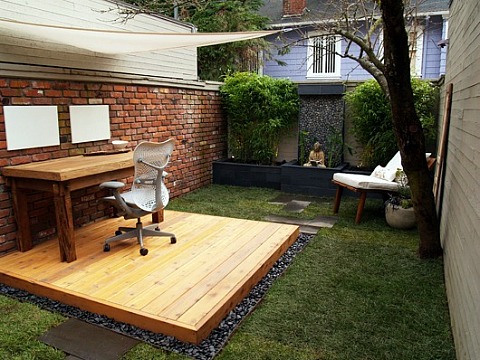
As summer winds down, Herman Miller Lifework posts a question and a roundup of  outdoor work spaces. An Aeron Chair in a zen garden looks pretty sexy in a photo; but could you actually do computer work there? Let's hope the sprinkler timer is off!

Get the full story HERE
 Here at Whereuwork we remain uneasy about knitting widely different work and leisure activities together. Is anything gained by 'working' on an ipad in a park? We suspect that both realms are diminished - one's appreciation of nature as well as one's ability to do meaningful work. Multitasking can be overrated.

Wednesday, August 17, 2011

Letterpress Fetish

Letterpress printing has a cult status among graphic artists. It is mythical, reaching back in time to when printing was a very physical act - before the clicking & dragging disconnect of digital art and web pages.

Paul Shaw from Print magazine recently spent a weekend near Milan with Lucio Passerini, an Italian typographer of some reknown, and he wrote up a nice non-print profile of their visit. What Whereuwork likes so much about this report is the focus on Lucio's workshop - Il Buon Tempo - the physical space where he creates.

Type Banks
My childhood Saturdays were often spent playing in the pressroom of a weekly newspaper. My father was editor, reporter and chief bottle-washer in a pre-offset world. The smells of molten lead, ink-soaked wood and crisp newsprint come rushing back to me, looking at this photo.I long for the physical constructs of the printed word.

Get the full story here - IMPRINT


Thursday, August 11, 2011

How Skinny can you go?

Keret House, Warsaw
 With much of this country reeling from McMansion overload, designers have focused on going small for home and office. But Jakub Szczesny takes it to a new level with his Keret House in Warsaw, Poland. It is so small, so narrow that it defies description. We like that he called it an art project and thereby avoided building codes - Art Power! The question remains - how much is too little? Could you really live or work here without flipping out?

Get the full story HERE

Monday, August 1, 2011

Is there Creative Life Beyond the Cubicle?

Does anyone actually work here?
 Allison Arieff, former editor of Dwell magazine, design maven and NY Times blogger, examines the stark differences between  the image of the office cubicle, as promoted by high-design modular furniture companies, and the down to earth, ad-hoc places where many creatives actually do their work. She asked the provocative question, is there a better big-new-idea than the cubicle - and boy did she get responses. Most people railed against the cube, a few suggested only a private closed office will do; but no-one really described anything remotely new or different.

Making it real: a creative comfort zone
Ideas about work spaces range from interesting to absurd, but we are always curious to see the actual places where creative people work. Most telling was Andrew Berardini's musing on his own, very real desk.The differences between the real and the ideal seem to be vast.
Get the full story here: Beyond the Cubicle

Tuesday, July 19, 2011

Izzy's Funhouse

When the Circus came to Town.
We have heard stories about the wild and playful places where some people work - the Google and Pixar palaces with loads of kids toys for grownups. They sport foosball tables and basketball hoops to fool with while they wax creative. Forced fun for a captive audience, these corporate idea mills cannot hold a candle to Izzy's Funhouse.
He's a pinball wizard, that has to be a twist...
 Izzy is an artist and commercial photographer who collects iconic trappings of 20th century American life - such as Halloween masks, paint-by-number kits and pinball machines. It turns out that a photo studio and amusement arcade can coexist quite nicely. Mechanical Pinball and arcade machines reached a zenith of popularity in the 1960's, sucking kid's quarters like slot machines. These were sturdy workhorses, designed for punishing use. Many machines are still in existence, though they now could use some TLC, if not outright rebuilding. Izzy is a handy guy, and so a corner of the photo studio has become a dedicated renovation shop for vintage arcade games.

Pre-circuit board technology
The inside of a vintage pinball machine is a collection of coils, switches, solenoids, lights and levers. This is old-school analog technology at its best. Needlenose pliers, dust brush, tweezers and a soldering iron are the preferred tools here.


The studio is in a nondescript one-story business park, about as anonymous as can be. Izzy says he misses his old Midtown Sacramento studio with its friendly neighbors, restaurants and services in easy walking distance. But more space, better layout and lower rent just make good business sense. Between photo assignments he tinkers with an old wood-rail machine, preparing for the Pacific Pinball Expo in September. It is an enviable creative environment in which to work, with stress relief always right at hand. Eat your heart out, Pixar.
Izzy Schwartz is an artist, commercial photographer and arcade aficionado residing in Sacramento. His work can be found HERE 

Wednesday, July 13, 2011

Ghost Lab Design Conference 2011

Nova Scotia site of the Ghostlab
Architect Bryan McKay-Lyons has run a summer design/build camp for creative architectural students for the past dozen years. This year, he decided a conference would be a nice change. Esteemed luminaries such as Rick Joy, Glenn Murcutt, Kenneth Frampton and Ted Flato joined nearly 200 others for this June gathering to talk about architecture, sustainability and place. Wouldn't it be something to get an invite to the Ghostlab 2012 conference!

Full story here -
Ghost Lab 2011 | Editorial | Architectural Record